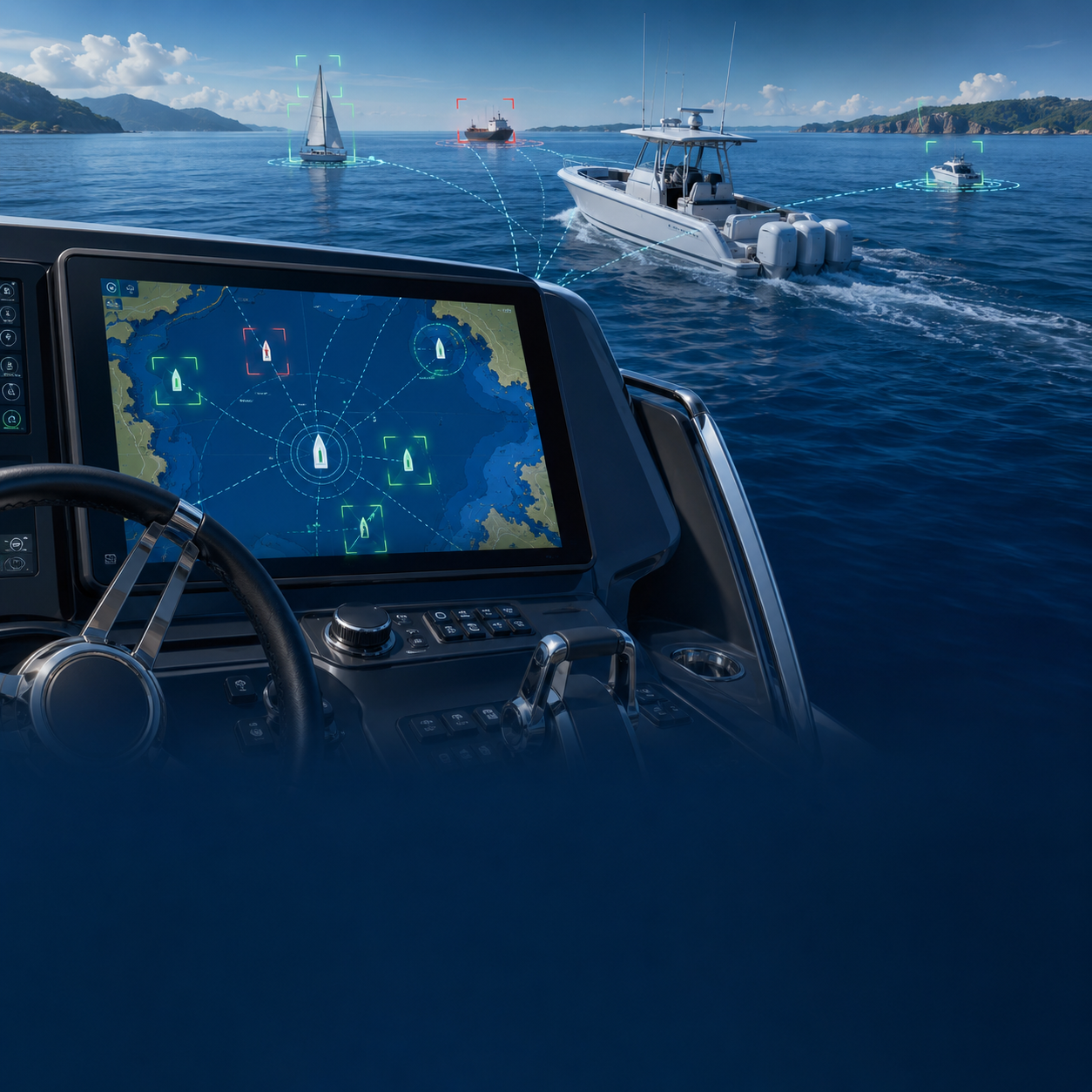
Modern boating is safer, smarter, and more connected than ever. But with so many marine electronics available, it can be confusing to understand what each system actually does.
Three of the most important technologies on many boats are AIS, radar, and the chartplotter.
They are often shown on the same helm display, but they are not the same thing. Each one plays a different role:
AIS helps you identify other vessels.
Radar helps you see objects around you.
A chartplotter helps you understand where you are and where you are going.
Used together, these systems can give you a much better picture of what is happening around your boat.
At marine.shop, we carry a wide range of navigation electronics, AIS systems, chartplotters, NMEA 2000 cables, GPS accessories, and vessel monitoring products to help boaters build safer and more capable helm setups.
What is AIS?
AIS stands for Automatic Identification System.
AIS allows equipped vessels to send and receive information such as vessel name, position, speed, course, heading, and other navigation data. When connected to a compatible chartplotter or multifunction display, AIS targets can appear directly on your screen.
In simple terms, AIS helps you answer:
Who is that vessel?
Where is it going?
How fast is it moving?
Is it getting closer to me?
Could it become a collision risk?
AIS is especially useful around commercial traffic, busy channels, bridges, inlets, harbors, shipping lanes, and offshore passages.
A product like the Simrad NAIS-500 Class B AIS Splitter, GPS and N2K is an example of an AIS system designed to integrate with modern marine electronics and NMEA 2000 networks.
Another option is the Digital Yacht AIT6000 Nucleus Class B+ AIS Transponder with SPAIS Satellite AIS Compatibility, which is suited for boaters looking to add advanced AIS capability to their navigation setup.
Who needs AIS?
AIS is valuable for more boaters than many people realize.
You should strongly consider AIS if you:
Cruise at night
Boat in busy waterways
Travel offshore
Cross shipping channels
Run in low visibility
Navigate around commercial vessels
Cruise with family or guests
Operate a yacht, center console, sportfish, sailboat, or cruising boat
Want better awareness of nearby vessel traffic
For recreational boaters, AIS is not only about seeing large ships. It can also help you identify other AIS-equipped yachts, sailboats, commercial vessels, ferries, tugs, and fishing boats.
AIS does not replace good seamanship, lookout, radar, or navigation judgment. But it adds a very useful layer of information.
What is radar?
Radar helps detect objects around your boat by sending out radio waves and receiving reflections from other objects.
Unlike AIS, radar does not depend on another vessel having equipment installed. Radar can help detect:
Other boats
Land
Rain cells
Markers
Bridges
Shorelines
Large floating objects
Storm activity
Navigation hazards
Radar is especially useful at night, in fog, in rain, and in situations where visual visibility is limited.
That is one of the biggest differences between radar and AIS:
AIS shows you information from vessels that are transmitting AIS.
Radar helps you detect objects whether or not they are transmitting anything.
For many boaters, radar is one of the most important safety upgrades because it helps you “see” beyond what your eyes can easily confirm.
You can browse marine radar options in the Radar collection at marine.shop.
What is a chartplotter?
A chartplotter, also called a multifunction display or MFD, is the central screen at the helm that helps you navigate.
A chartplotter can display:
Electronic charts
Boat position
Routes and waypoints
Depth information
AIS targets
Radar overlay
Engine data
NMEA 2000 sensor data
GPS information
Fishfinder/sonar data, depending on setup
Think of the chartplotter as the main dashboard for your navigation electronics.
Products like the Simrad NSX3007 7in MFD with 83/200kHz HDI, B&G Vulcan 9 MFD with C-MAP Discover Chart, and Lowrance HDS16 Pro 16in MFD C-MAP US & Canada No Transducer are examples of displays that can become the central interface for a modern helm setup.
AIS vs. radar: what is the difference?
AIS and radar are often used together, but they do very different jobs.
AIS identifies equipped vessels and provides data about them.
Radar detects objects around your boat, whether or not they are transmitting AIS.
For example, AIS may tell you the name, speed, and course of a cargo ship several miles away. Radar may help you see a small boat, shoreline, rain squall, or unmarked object that has no AIS signal.
The best setup is not usually AIS or radar. For many boats, it is AIS and radar, displayed through a good chartplotter.
AIS vs. chartplotter: what is the difference?
AIS is the information source.
The chartplotter is where you usually see that information.
An AIS transponder or receiver gathers vessel traffic data. A compatible chartplotter can then display that data on the chart screen so you can see nearby vessels relative to your own position.
That is why compatibility matters.
Before buying AIS equipment, make sure your existing display, network, antenna setup, and NMEA 2000 backbone can support the installation.
Products like the Lowrance N2KEXT-2RD Extension 2ft NMEA 2000 Cable, Actisense A2K-4WT NMEA2000 Micro 4-Way T, and Ancor 270112 NMEA 2000 Blanking Cap - Male are examples of accessories that may be useful when building or expanding a NMEA 2000 network.
Why you may need all three
A strong helm setup uses different electronics for different layers of awareness.
A chartplotter shows your position and route.
AIS shows nearby transmitting vessels and their movement.
Radar helps detect objects and conditions around you.
Together, they help answer the most important questions while underway:
Where am I?
Where am I going?
What vessels are around me?
Are any of them on a possible collision course?
What is around me that may not be transmitting AIS?
Is weather or visibility becoming a problem?
Do I have enough information to make a safe decision?
For coastal cruising, Bahamas crossings, offshore fishing, Great Loop segments, night runs, or busy South Florida waterways, combining these systems can make boating safer and less stressful.
Example setups by boat type
Center console or small powerboat
A center console may not need a huge electronics package, but a smart setup can make a major difference.
Suggested products to consider:
Simrad NSX3007 7in MFD with 83/200kHz HDI
Simrad NAIS-500 Class B AIS Splitter, GPS and N2K
Lowrance N2KEXT-2RD Extension 2ft NMEA 2000 Cable
Ancor 270112 NMEA 2000 Blanking Cap - Male
This type of setup can help with navigation, traffic awareness, and clean electronics integration without overcomplicating the helm.
Cruising boat or sailboat
Cruising boats often benefit from better route planning, AIS visibility, and reliable chart display.
Suggested products to consider:
B&G Vulcan 9 MFD with C-MAP Discover Chart
Digital Yacht AIT6000 Nucleus Class B+ AIS Transponder with SPAIS Satellite AIS Compatibility
Actisense A2K-4WT NMEA2000 Micro 4-Way T
Lowrance N2KEXT-2RD Extension 2ft NMEA 2000 Cable
AIS can be especially useful for sailboats and cruising vessels because it helps other vessels see you and helps you monitor traffic during longer passages.
Yacht or larger helm
Larger boats often need more screen space, more integration, and better visibility across multiple systems.
Suggested products to consider:
Lowrance HDS16 Pro 16in MFD C-MAP US & Canada No Transducer
Simrad NAIS-500 Class B AIS Splitter, GPS and N2K
Maretron VDR100 Vessel Data Recorder
Maretron IPG100-01 Internet Protocol Gateway
Maretron TMP100-01 Temperature Module
For yachts, AIS, radar, chartplotter, NMEA 2000 data, and vessel monitoring can work together to create a much more complete picture of the boat and its surroundings.
Installation and compatibility tips
Before adding AIS, radar, or a new chartplotter, check the full system.
Important questions include:
Is your display compatible with the AIS or radar system?
Does your boat already have a NMEA 2000 backbone?
Is there room to expand the network?
Do you need additional cables, T-connectors, or terminators?
Is the antenna setup correct?
Will the equipment fit your helm layout?
Are the products compatible with your existing brand ecosystem?
Should the installation be handled by a qualified marine electronics installer?
For clean installations, do not overlook the small parts. NMEA 2000 cables, connectors, blanking caps, and proper network design can matter just as much as the main electronics.
You can browse marine.shop’s Navigation collection for AIS systems, chartplotters, GPS accessories, NMEA 2000 cables, sensors, and vessel monitoring products.
Final thoughts
AIS, radar, and chartplotters each solve a different problem.
AIS helps you identify nearby vessels.
Radar helps detect objects and conditions around you.
A chartplotter brings navigation information together on one screen.
For some boaters, a basic chartplotter may be enough. But if you cruise in busy waterways, run at night, travel offshore, cross shipping lanes, or want better awareness around your boat, AIS and radar can be valuable upgrades.
The best marine electronics setup is not just about adding more screens. It is about building a system where the right information is available when you need it.
Explore navigation electronics, AIS systems, chartplotters, NMEA 2000 accessories, and vessel monitoring products at marine.shop to build a smarter and safer helm.