
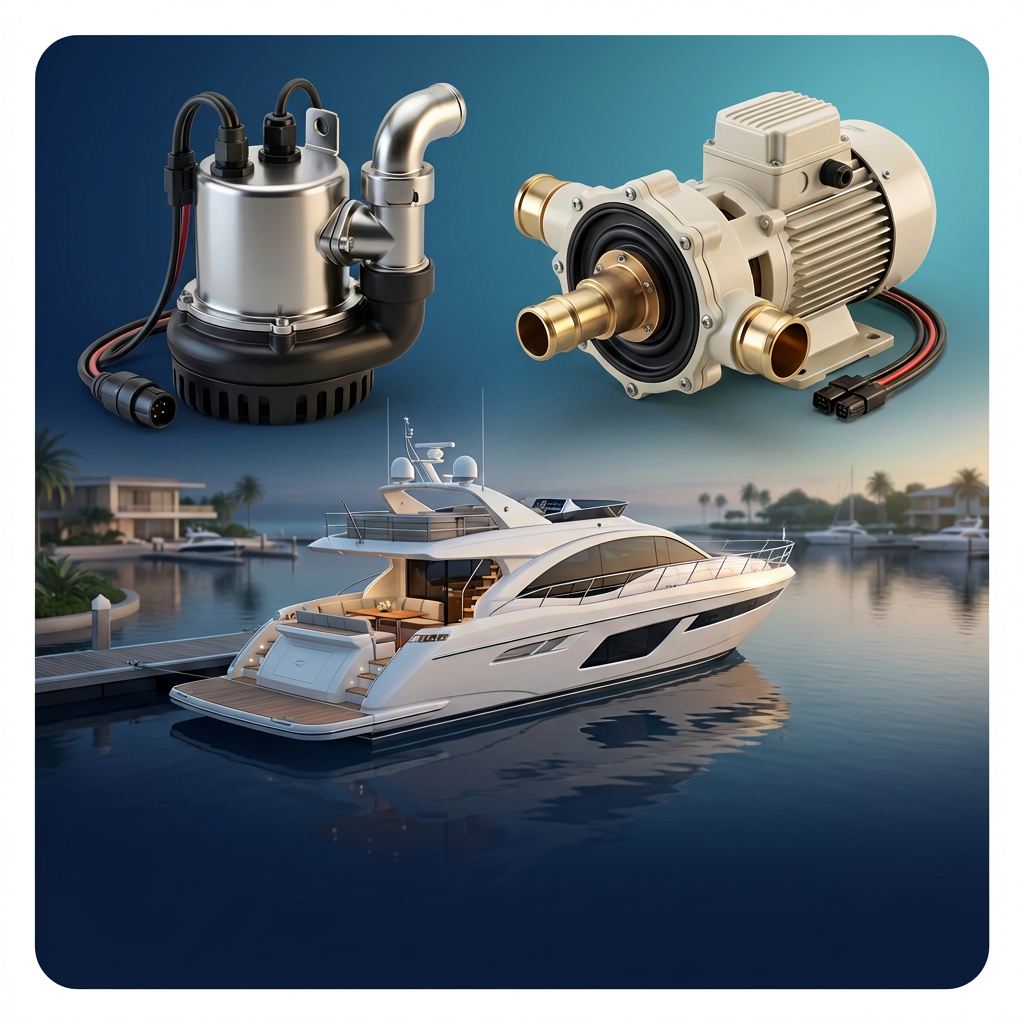
Bilge Pump Basics: How to Choose the Right Pump for Your Boat
A bilge pump is one of the most important safety and maintenance items on a boat. It may not be the most exciting piece of equipment, but when water starts collecting where it should not, the bilge pump becomes one of the first systems you want working properly.
The bilge is the lowest part inside the boat where water can collect from rain, spray, washdown, small leaks, condensation, shaft seals, plumbing, or normal use. A good bilge pump helps move that water out of the boat and overboard before it becomes a bigger problem.
At marine.shop, we like to think about bilge pumps by real boating situation: small boats, center consoles, cruisers, 24V systems, tight bilge spaces, and boats that need a drier bilge after washdowns or heavy rain.
Here is how to choose the right bilge pump for your boat.
1. Small Boats and Tight Bilge Spaces
Smaller boats often have limited space in the bilge. This can include skiffs, tenders, small center consoles, bay boats, flats boats, and day boats where a compact pump is easier to install and maintain.
In this situation, size matters. You want a pump that can fit into a narrow or low bilge area, move water efficiently, and still be easy to clean if debris reaches the strainer.
Featured product:
· Whale Supersub 500 GPH Bilge Pump 12V (Model SS5012)
The Whale Supersub 500 GPH is a strong fit for small boats and narrow bilge spaces. It is a 12V pump with a low-profile design, rotating outlet and pump body, easy-clean strainer, integrated bleed ball to help prevent air locks, and 500 GPH open flow performance.
This is the type of pump that makes sense when the bilge area is tight and the goal is to keep the system simple, compact, and reliable.
Best for:
· Small boats, skiffs, tenders, bay boats, small center consoles, and narrow bilge compartments.
View product:
https://marine.shop/products/whale-supersub-500-gph-bilge-pump-12v
2. Center Consoles and Everyday 12V Boats
For many center consoles, runabouts, fishing boats, and family day boats, an 800 GPH pump is a practical middle-ground option. It offers more capacity than a very small pump without going into a large heavy-duty setup.
This category is useful for boats that see regular use, occasional rain, washdown water, spray, and normal bilge accumulation.
Featured product:
· Attwood Sahara MK2 S800 12VDC 5 Amp Bilge Pump (Model 5508-7)
The Attwood Sahara MK2 S800 is a 12V bilge pump rated at 800 GPH. The marine.shop product page lists it with a 4A fuse size and 3/4-inch and 1-inch barb outlet options, making it a practical choice for many everyday 12V installations.
This is a good option for boaters who want a dependable general-purpose bilge pump for typical recreational boating use.
Best for:
· Center consoles, runabouts, small fishing boats, family boats, and everyday 12V bilge pump replacement.
View product:
https://marine.shop/products/attwood-sahara-mk2-s800-12vdc-5-amp-bilge-pump
3. Larger Boats That Need More Pumping Capacity
Larger boats, cruisers, sportfish boats, and boats with deeper bilges may need more pumping capacity. In these situations, a small pump may still be useful as a secondary or nuisance-water pump, but the main bilge pump should be sized for more serious water movement.
A high-capacity pump is especially important in engine rooms, deeper bilge areas, or boats that operate offshore or spend more time exposed to rain, spray, and rougher conditions.
Featured product:
· Attwood Heavy Duty HD2000 12VDC 7 Amp Bilge Pump (Model 4760-4)
The Attwood Heavy Duty HD2000 is a higher-capacity 12V bilge pump designed for heavier use. The product listing notes heavy-duty construction, long-life brushes and magnets, chemical-resistant exterior resin, and output over 2000 GPH while drawing less than 7 amps.
This is the kind of pump category to consider when you want stronger bilge water evacuation for a larger 12V boat or as part of a more serious bilge system.
Best for:
· Cruisers, larger center consoles, sportfish boats, engine rooms, and higher-capacity 12V bilge systems.
View product:
https://marine.shop/products/attwood-heavy-duty-hd2000-12vdc-7-amp-bilge-pump
4. 24V Boats and Automatic Narrow-Bilge Installations
Many larger boats and yachts use 24V systems. In that case, you should not simply install a 12V bilge pump unless the circuit is specifically designed for it. Matching the pump voltage to the boat’s electrical system is important for safe and proper operation.
For some 24V boats, especially those with tight spaces under engines or cockpit floors, a compact automatic pump can be very useful.
Featured product:
· Whale Supersub Smart 1100 GPH Bilge Pump 24V (Model SS1224)
The Whale Supersub Smart 1100 GPH is a 24V automatic low-profile bilge pump. The product page notes that it requires no separate bilge switch, is designed for narrow bilge spaces, is suitable for fresh and saltwater, uses low power consumption, and includes an integrated bleed ball to help prevent air locks.
This is a strong option for larger 24V boats where space is tight and automatic operation is preferred.
Best for:
· 24V boats, larger cruisers, yachts, tight bilge spaces, under-engine spaces, and automatic bilge pump installations.
View product:
https://marine.shop/products/whale-supersub-smart-1100-gph-bilge-pump-24v
5. Automatic Switching and Better Bilge Control
A bilge pump is only part of the system. The switch matters too.
Some pumps are automatic and have built-in sensing. Others need a separate automatic bilge switch. A good switch helps the pump activate when water reaches a certain level and shut off when the water is removed.
This is important because you do not want to rely only on manual operation from the helm. A manual switch is useful, but an automatic bilge setup adds another layer of protection when the boat is sitting at the dock, stored, or unattended.
Featured product:
· Attwood S3 Automatic Bilge Switch 12VDC 15 Amp (Model 4801-7)
The Attwood S3 Automatic Bilge Switch is designed to activate a bilge pump automatically. The marine.shop product page notes that it can be mounted on the bilge floor, directly to a stringer wall, or alongside the pump basket without extra components or brackets. It is also listed as marine ignition protected and free of moving parts that can jam, break, or wear out over time.
This is a smart add-on when you are building or upgrading a 12V bilge pump system that needs automatic activation.
Best for:
· 12V bilge pump systems, automatic pump activation, replacement switch upgrades, and added protection when the boat is unattended.
View product:
https://marine.shop/products/attwood-s3-automatic-bilge-switch-12vdc-15-amp
6. Keeping the Bilge Drier After Rain, Washdown, and Spray
A standard bilge pump is designed to remove water once it reaches the pump pickup level. But many boats still retain a small amount of water in low spots, steps, compartments, or areas where the main pump cannot fully reach.
That leftover water can create odor, moisture, mildew, corrosion, and a dirty bilge over time. For boaters who want a cleaner and drier bilge, a dry bilge system can be a good upgrade.
Featured product:
· Bilge-B-Dry Single Pump 12V Dry Bilge System (Model BBD-2025-121)
The Bilge-B-Dry Single Pump 12V Dry Bilge System is designed to remove excess bilge water that may remain after washdown, heavy rain, sea spray, rough seas, or water sitting forward of a stepped hull. The product listing notes smart-device-enabled operation, customizable scheduling through a mobile app, a diaphragm pump design that can run dry for extended periods, and compact installation in tight or awkward spaces.
This is not a replacement for a proper emergency bilge pump. It is better understood as a dry-bilge management system that helps keep the bilge cleaner and drier after normal boating use.
Best for:
· Boats with wet bilges, stepped hulls, boats stored outside, boats exposed to heavy rain, and owners who want a cleaner engine room or bilge area.
View product:
https://marine.shop/products/bilge-b-dry-single-pump-12v-dry-biilge-system
7. How Much GPH Do You Need?
Bilge pumps are usually rated in GPH, or gallons per hour. This rating helps describe how much water the pump can move under ideal conditions.
As a general rule:
· Small boats may use compact pumps around 500 GPH.
· Medium recreational boats often use pumps around 800 to 1100 GPH.
· Larger boats, cruisers, and offshore boats may need higher-capacity pumps such as 1500 to 2000+ GPH.
· Larger boats may also need more than one pump in different bilge areas.
It is also important to remember that real-world performance can be lower than the advertised open-flow number. Hose length, head height, bends, fittings, voltage, and restrictions can all reduce actual output.
8. Manual vs. Automatic Bilge Pumps
There are two basic ways a bilge pump can operate: manually or automatically.
A manual pump requires someone to turn it on from a switch. An automatic pump or automatic switch activates when water reaches a certain level.
For most powered boats, an automatic setup is strongly preferred because the boat may collect water when no one is watching. That could happen during rain, while sitting at the dock, or after a small leak develops.
The best setup often includes both:
· Automatic operation for normal protection.
· Manual override from the helm or electrical panel.
This gives the owner control while still allowing the pump to protect the boat when unattended.
9. Do You Need One Pump or Multiple Pumps?
One bilge pump may be enough for a small boat, but many boats benefit from multiple pumps.
For example, a larger boat may have:
· A forward bilge pump.
· An engine room bilge pump.
· A shower sump or grey water pump.
· A high-water backup pump.
· A dry bilge system for nuisance water.
Multiple pumps can help because water may collect in more than one low point. They also create redundancy if one pump or switch fails.
If your boat has separate compartments, bulkheads, or areas where water does not naturally flow to one low point, it may need more than one pump.
10. Installation Details Matter
Even a good bilge pump can perform poorly if it is installed incorrectly.
Before installing or replacing a bilge pump, check:
· Pump voltage: 12V or 24V.
· GPH rating.
· Hose diameter.
· Discharge height.
· Wiring size.
· Fuse size.
· Switch type.
· Check valve use, if appropriate.
· Access for cleaning.
· Location of the outlet through-hull.
The pump should be mounted where water naturally collects. The hose should be routed as cleanly as possible, with minimal sharp bends. Wiring should be marine grade, properly fused, and protected from moisture and abrasion.
If the system is complex or tied into a larger yacht electrical setup, a qualified marine technician should review the installation.
Final Thoughts
A bilge pump is not just another accessory. It is one of the core safety and maintenance systems on a boat.
For a small boat or tight bilge, a compact low-profile pump like the Whale Supersub 500 GPH may be the right fit. For everyday center consoles and runabouts, the Attwood Sahara MK2 S800 offers a practical 12V option. For larger 12V boats, a higher-capacity pump like the Attwood Heavy Duty HD2000 makes sense. For 24V automatic installations, the Whale Supersub Smart 1100 GPH is a strong choice. And for owners who want a cleaner, drier bilge after normal use, the Bilge-B-Dry system can be a smart upgrade.
Before ordering, confirm your boat’s voltage, available space, hose size, pump capacity needs, and whether you need manual, automatic, or backup operation.
marine.shop offers a growing selection of bilge pumps, automatic bilge switches, dry bilge systems, washdown pumps, freshwater pumps, and marine plumbing accessories for boaters who want reliable water management on board.
Shop the full Pumps collection: