NMEA 2000 Made Simple: How Your Boat Electronics Talk to Each Other
Modern boats are no longer just mechanical machines. Today’s boats rely on electronics to navigate, monitor engines, track AIS targets, display depth, show fuel levels, manage sensors, and help captains make better decisions on the water.
That is where NMEA 2000 comes in.
If you have ever wondered how your chartplotter receives GPS position, engine data, AIS information, heading, depth, temperature, or tank levels from different devices, the answer is usually some version of a marine electronics network. For many modern boats, that network is NMEA 2000.
Think of it as the communication system that allows your boat’s electronics to “talk” to each other.
At marine.shop, we carry a wide range of navigation electronics, NMEA 2000 cables, connectors, sensors, AIS systems, GPS accessories, and monitoring products that can help build, expand, or improve your onboard electronics network.
What is NMEA 2000?
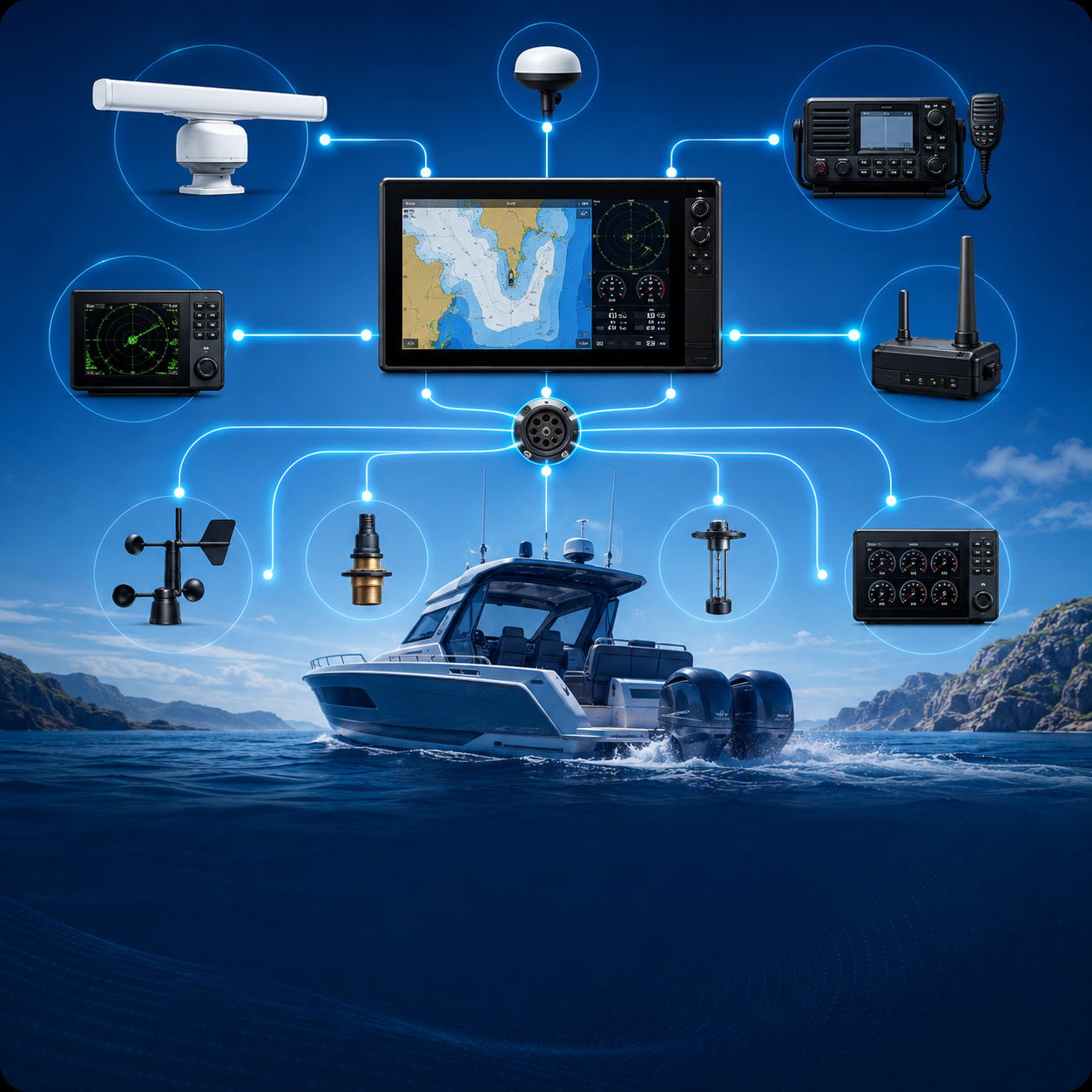
NMEA 2000, often called N2K, is a marine data network used to connect compatible electronics and sensors on a boat. Instead of each device working alone, NMEA 2000 allows many devices to share information across one common backbone.
For example, a properly installed NMEA 2000 network can allow your:
Chartplotter to display AIS targets
GPS antenna to send position data to multiple displays
Engine sensors to show RPM, fuel burn, or alarms
Tank sensors to report fuel, water, or waste levels
Weather instruments to share wind and temperature data
AIS transponder to communicate with your navigation display
Monitoring devices to record or transmit vessel data
The benefit is simple: instead of having scattered information across separate systems, NMEA 2000 helps bring key boat data together.
Why NMEA 2000 matters on real boats
A good electronics network is not just about convenience. It can improve safety, troubleshooting, and situational awareness.
When your boat electronics communicate properly, you can make faster decisions. You can see more information from the helm. You can understand what the boat is doing. You can detect issues earlier. And you can reduce the amount of duplicated wiring needed behind the dash.
For coastal cruisers, yacht owners, center console captains, and offshore boaters, this matters because conditions change quickly. Having GPS, AIS, radar, engine data, depth, and sensor information working together can make the difference between guessing and knowing.
The basic parts of a NMEA 2000 network
A NMEA 2000 system usually has a few basic components.
1. The backbone
The backbone is the main communication line. Devices connect into this backbone using T-connectors, drop cables, and extension cables.
This is the “highway” that carries information between your electronics.
A product such as the Lowrance N2KEXT-2RD Extension 2ft NMEA 2000 Cable can be used when extending or connecting parts of a NMEA 2000 installation.
2. T-connectors and multi-port connectors
Each device normally connects to the backbone through a T-connector or network connector. For systems with multiple nearby devices, a multi-port connector can help keep the installation cleaner.
The Actisense A2K-4WT NMEA2000 Micro 4-Way T is a good example of a connector used when multiple drop connections are needed from the NMEA 2000 backbone.
3. Network power
A NMEA 2000 network needs proper power. This should be installed correctly, protected with the right fuse, and configured so the network is not accidentally powered from multiple sources.
This is one area where a qualified marine electronics installer is strongly recommended.
4. Termination and protection
A NMEA 2000 backbone normally requires termination at both ends. Missing or incorrect terminators can cause communication problems, intermittent device behavior, or data dropouts.
Small accessories such as caps, terminators, and blanking caps may not look exciting, but they are important for a clean and reliable network.
The Ancor 270112 NMEA 2000 Blanking Cap - Male is an example of a simple but useful accessory for protecting unused network connections.
5. Devices and sensors
Once the backbone is in place, compatible devices can be connected. These may include chartplotters, AIS units, temperature modules, tank sensors, current monitors, GPS receivers, engine gateways, and data recorders.
This is where NMEA 2000 becomes powerful: your electronics stop acting like separate boxes and start acting like a system.
What kind of data can NMEA 2000 share?
Depending on your boat and equipment, a NMEA 2000 network can share many types of information, including:
GPS position
Speed over ground
Course over ground
Heading
Depth
Water temperature
Wind speed and direction
AIS targets
Engine RPM
Fuel flow
Battery voltage
Tank levels
Temperature readings
Alarms and system status
Vessel monitoring data
For example, a product like the Maretron TMP100-01 Temperature Module can broadcast multiple temperature readings over a NMEA 2000 network. This can be useful for monitoring areas such as the cabin, engine room, equipment spaces, inverters, chargers, pumps, or other onboard systems.
For more advanced monitoring, the Maretron CLM100 Current Loop Monitor can convert analog transducer data into digital NMEA 2000 data, making it easier to display and monitor information through compatible systems.
NMEA 2000 and AIS
AIS is one of the most practical reasons to build or improve a NMEA 2000 network.
An AIS transponder allows your boat to send and receive vessel information, helping you see nearby commercial traffic, yachts, and other AIS-equipped vessels. When connected to a compatible chartplotter or multifunction display, AIS targets can appear directly on your screen.
For busy waterways, night cruising, offshore passages, and ports with commercial traffic, AIS can be a major safety upgrade.
The Simrad NAIS-500 Class B AIS Splitter, GPS and N2K is a strong example of an AIS product designed to integrate with marine electronics and NMEA 2000 networks.
Another option is the Digital Yacht AIT6000 Nucleus Class B+ AIS Transponder, which is suited for boaters looking to add AIS capability to their navigation setup.
NMEA 2000 and vessel monitoring
One of the biggest advantages of NMEA 2000 is that it is not limited to navigation. It can also support vessel monitoring.
That means your network can help track what is happening around the boat: temperatures, tanks, electrical information, engine data, and system status.
The Maretron VDR100 Vessel Data Recorder is a good example of how NMEA 2000 data can be recorded for later review. This type of product can be useful for performance analysis, vessel tracking, preventive maintenance, and troubleshooting.
For owners who want more visibility into what their boat is doing, vessel monitoring is one of the most valuable uses of a NMEA 2000 network.
For more advanced connected systems, the Maretron IPG100-01 Internet Protocol Gateway can also be considered as part of a larger vessel monitoring or data-sharing setup.
Chartplotters and multifunction displays
The chartplotter or multifunction display is usually where the captain sees the benefit of the network.
A display can bring together charting, GPS, depth, AIS, radar, engine information, and other data depending on the connected equipment.
Products such as the Simrad NSX3007 7in MFD, B&G Vulcan 9 MFD with C-MAP Discover Chart, and Lowrance HDS16 Pro 16in MFD are examples of modern navigation displays that can become the central interface for a larger electronics system.
The right display depends on your boat, helm layout, cruising style, screen size preference, and the rest of your electronics ecosystem.
Common signs your NMEA 2000 network needs attention
A boat electronics network is easy to ignore until something stops working. Here are some common symptoms that may point to a network issue:
Devices randomly disappear from the display
AIS targets are not showing
GPS position is inconsistent
Engine data is missing
Depth or temperature data drops out
Alarms appear without a clear reason
Some devices work only after restarting the system
New equipment does not appear on the network
The network has messy wiring or exposed connectors
These problems do not always mean a device is bad. Sometimes the issue is a cable, connector, terminator, power point, or compatibility problem.
Before replacing expensive electronics, inspect the basics first.
Simple upgrade paths
You do not always need to replace the entire electronics system. Many boats can benefit from smaller upgrades.
For a small boat or center console
Start with a reliable multifunction display, GPS, depth/fishfinder, and clean NMEA 2000 cabling. Add AIS if you regularly cruise in busy areas.
Suggested products to consider:
Simrad NSX3007 7in MFD
Lowrance N2KEXT-2RD Extension 2ft NMEA 2000 Cable
Ancor 270112 NMEA 2000 Blanking Cap - Male
Simrad NAIS-500 Class B AIS Splitter, GPS and N2K
For a cruising boat
Focus on navigation, AIS, sensors, and monitoring. This gives you better awareness while underway and at anchor.
Suggested products to consider:
B&G Vulcan 9 MFD with C-MAP Discover Chart
Digital Yacht AIT6000 Nucleus Class B+ AIS Transponder
Maretron TMP100-01 Temperature Module
Maretron VDR100 Vessel Data Recorder
For a yacht or more complex system
A larger boat may need multiple displays, AIS, radar integration, temperature monitoring, tank monitoring, engine data, and remote data access.
Suggested products to consider:
Lowrance HDS16 Pro 16in MFD
Maretron IPG100-01 Internet Protocol Gateway
Maretron CLM100 Current Loop Monitor
Maretron VDR100 Vessel Data Recorder
Actisense A2K-4WT NMEA2000 Micro 4-Way T
Installation tips before adding new equipment
Before buying new NMEA 2000 products, check a few important details:
Confirm your current electronics are NMEA 2000 compatible.
Inspect the existing backbone layout.
Make sure the network has proper termination.
Check that power is supplied correctly.
Avoid powering the network from multiple places unless the system is designed for it.
Use marine-grade cables and connectors.
Protect unused connectors.
Verify compatibility between brands and devices.
Plan the network before adding several products at once.
A clean network is easier to troubleshoot, easier to expand, and more reliable on the water.
Final thoughts
NMEA 2000 may sound technical, but the concept is simple: it helps your boat electronics communicate.
When installed correctly, it can bring GPS, AIS, engine data, sensors, tank levels, temperature, and other key information into one connected system. That makes the boat easier to monitor, easier to troubleshoot, and safer to operate.
Whether you are upgrading a center console, improving a cruising boat, or building a more complete yacht electronics system, the right NMEA 2000 components can make your onboard technology work together instead of separately.
Explore marine.shop’s Navigation collection for chartplotters, AIS systems, GPS accessories, NMEA 2000 cables, connectors, sensors, and vessel monitoring products.